
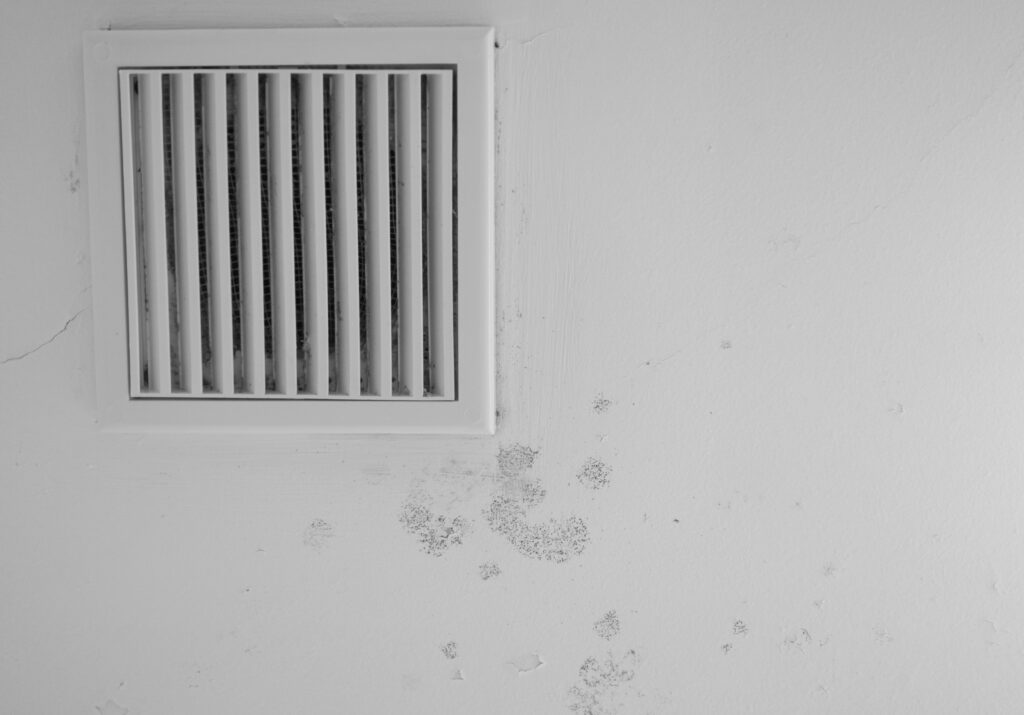
The ceiling around your bedroom vent has a faint brown ring that wasn’t there in June. Or maybe you caught a whiff of something musty the last time the air conditioner kicked on. In August, Fort Worth homes run their cooling systems nearly around the clock. That nonstop runtime sets up a problem most homeowners never see coming: condensation forming on ductwork, soaking insulation and drywall, and quietly feeding mold in places you can’t easily inspect.
Here’s the short answer up front. The AC duct mold summer pattern works like this: when humid attic air meets cold air in the duct, water condenses on the surface, similar to how it beads up on a cold glass. That moisture keeps duct insulation, ceiling materials, and framing damp for weeks at a stretch, and damp material plus Texas heat is exactly the recipe mold needs. If your ducts are sweating, the first step isn’t ripping anything out. It’s confirming whether mold has actually taken hold, and professional testing can answer that question definitively.
Mold Test DFW is a licensed mold inspection and testing company based in Fort Worth, and late summer is when calls about musty odors and stained ceilings pour in. If something in your home seems off, reach out for a free consultation, and we’ll help you figure out whether testing makes sense for your situation. No pressure, just straight answers.
Every duct in your home is a cold surface passing through hot, humid space. The air inside a supply duct typically runs around 55 to 60 degrees. The attic it travels through in a Fort Worth August can hit 130 degrees or more, loaded with moisture that rides in on Gulf air. When that humid air touches a duct surface colder than its dew point, the moisture in it turns to liquid water on the spot.
A few local factors make it worse here than in drier parts of Texas. Fort Worth summers combine triple-digit heat with humidity levels that keep dew points high well into the night, so ducts never get a chance to dry out. Many homes in neighborhoods from Keller to south Fort Worth have flex ducts with thin, compressed, or torn insulation jackets, which lets humid air reach the cold inner liner directly. With an oversized air conditioner, a common issue in fast-built subdivisions, cools the house so quickly that it shuts off before it has run long enough to pull humidity out of the air. The house feels cool but stays damp, which is why mold growth is a predictable seasonal pattern across Tarrant County rather than bad luck.
Condensation on its own is a plumbing-style problem. What turns an AC duct mold summer nuisance into an active colony is time. Mold spores are already present in virtually every home, and they only need about 24 to 48 hours on a damp surface to begin colonizing. A duct that sweats every afternoon for six weeks gives them dozens of fresh starts.
The tricky part about sweating ducts is where the water ends up. It doesn’t pool somewhere obvious. It soaks into the fiberglass insulation wrapped around the duct, drips onto the back side of your ceiling drywall, and wicks into wood framing and attic decking beneath duct runs. Growth starts on surfaces you’d only see by crawling through the attic or opening up a ceiling.
Many Fort Worth hidden mold cases start exactly this way. The homeowner sees nothing at all, or just a small stain they assume is from an old roof leak. Meanwhile, the system blows air across a contaminated surface, distributing spores to every room in the house. Air handler closets are another frequent culprit, since the unit itself sweats in the same way ducts do, and the closet traps that moisture in a small, dark space.
A few signals tend to show up before sweating ducts produce anything you can actually see. A musty, earthy odor that appears when the system first kicks on is the classic one, because the initial blast of air carries whatever has been sitting in the ducts. Brown or gray rings on the ceiling around supply registers point to condensation dripping from the duct boot. Water droplets on the grille itself, allergy symptoms that improve when you leave the house, and a condensate-backed-up drain line are all indicators of AC duct mold. Any one of these deserves a closer look, not a wait-and-see approach.
You don’t need special equipment to get a first read on the problem. A basic hygrometer from any hardware store will tell you your indoor relative humidity. The EPA recommends keeping indoor humidity below 60 percent, and ideally between 30 and 50 percent, to keep mold from gaining a foothold. If your home reads above 60 even while the air conditioner runs, your system isn’t dehumidifying effectively, and you likely have sweating ducts out of sight.
If you can safely access your attic, look along the duct runs for insulation that’s crushed, split, or visibly damp, and check whether any bare metal is exposed. Feel the decking under the ducts for softness or staining. Inside the house, resist the urge to crank the thermostat way down during a heat wave. Colder supply air makes duct surfaces colder, which makes condensation form faster. Keeping the setting moderate and letting the system run longer cycles actually removes more humidity than short blasts of deep cooling.
These checks tell you whether conditions favor an AC duct mold problem in your home. They can’t tell you whether spores have already colonized your ductwork or wall cavities. That’s where testing comes in.
Guessing gets expensive in both directions. Homeowners sometimes pay for duct cleaning or demolition they didn’t need, and sometimes paint over a stain that was hiding an active colony. Professional mold testing replaces guessing with lab data. At Mold Test DFW, that means a visual inspection of the system and moisture-prone areas, moisture mapping and thermal imaging to trace where water has traveled behind walls and ceilings, and air and surface sampling analyzed by an accredited laboratory. The lab-certified report tells you which species are present, at what concentrations, and how your indoor air compares to the air outside, so any cleanup that follows targets the roots.
There’s also a consumer protection angle worth knowing. Texas licenses mold assessors and mold remediators separately through the Texas Department of Licensing and Regulation, and state rules generally keep the company that tests for mold independent from the company that removes it on the same project. An independent testing company has no financial incentive to inflate findings. If remediation turns out to be necessary, follow-up testing afterward verifies the work succeeded and gives you a clean report you can keep, which matters enormously if you ever sell the house.
It can affect some people noticeably. Ducts distribute air throughout the house, so spores from one contaminated section reach every room. Common reactions include congestion, coughing, irritated eyes, and worsened asthma or allergy symptoms. August mold growth is often mistaken for seasonal allergies until testing identifies the real source.
Sampling answers this. Comparing air samples from different rooms against an outdoor baseline, along with surface samples from registers and suspect areas, narrows down where spores are concentrated. An inspection that typically takes 45 to 90 minutes for an average home, the ductwork, HVAC components, and moisture-prone rooms are evaluated.
It helps, because warmer supply air keeps duct surfaces above the dew point, but it doesn’t fix torn insulation or indoor humidity problems, and it does nothing about growth that has already started. Treat thermostat adjustments as a preventative measure against AC duct mold growth, not as a fix for existing contamination.
Sweating ducts don’t announce themselves, and by the time a stain shows up on the ceiling, a Fort Worth hidden mold problem has usually been at work for weeks. Mold Test DFW provides independent mold inspection and testing for houses, apartments, and commercial buildings across Fort Worth, Dallas, and more than 80 surrounding communities. If this August has your home smelling musty or your ceilings showing rings, get in touch through our contact page and let’s find out what’s really going on behind those vents. Answers first, decisions second.

Ryan Rainey is the owner of Mold Test DFW, a mold testing and inspection company serving homeowners, apartment residents, and commercial property owners throughout the Dallas-Fort Worth metroplex. Ryan and his inspectors identify moisture sources, assess water damage, and collect air, swab, tape lift, and bulk samples for laboratory analysis. Typical inspections run 45 to 90 minutes and end with clear recommendations for repair and prevention, whether the visit was prompted by allergy symptoms, a musty smell, or a real estate transaction. Mold Test DFW serves communities across the metroplex, from Fort Worth and Arlington to Plano, Frisco, and McKinney, and has earned a five-star rating from local customers. On the blog, Ryan shares what he sees in the field every week to help North Texans understand mold, moisture, and indoor air quality.