


Serving Dallas and Fort Worth, TX

Mold Testing in Allen, Texas

Mold Testing When You Are Under Contract in Allen

There is an executed contract on a house in Allen and a clock running. Maybe the general inspection came back with a note about staining under a sink, or a smell in a closet on an exterior wall, or a moisture reading somebody wrote down without explaining. Whatever prompted it, the question now has a deadline attached, and the answer has to be in a form an agent can attach to an amendment.

Mold Test DFW performs mold assessment only, never remediation, so nothing in the findings is a pitch for our own next invoice. What comes back is a written assessment of a named address: what was found, in which rooms, on which materials, and what moisture condition is keeping it there. A document like that has to be answered. A verbal impression does not. Mold testing in a transaction has one job, which is to put a record where an impression was.

The Five-Year Certificate History a Seller Owes You

Texas puts a disclosure duty on the seller that most buyers have never heard of. Under Texas Occupations Code Sec. 1958.154(b), a property owner who sells a property must give the buyer a copy of each certificate issued for that property under that section during the five years preceding the sale.

Read that carefully, because the wording is doing work. The duty is to hand over copies of the certificates themselves, not to summarize them, and not to answer a general question about whether there has ever been mold. That means a buyer can ask for them specifically, by name and by date, and a seller who has one is obliged to produce it. What comes back also changes what mold testing needs to look for.

100% Privacy Guarantee

What a Certificate of Mold Remediation Actually Says

The duty exists because of what those certificates are. Sec. 1958.154(a) requires a license holder who completes mold remediation to give the owner a certificate of mold remediation within ten days. That certificate has to carry a statement from a mold assessment license holder. The statement says that, based on visual, procedural and analytical evaluation, the contamination identified for the project was remediated as the plan or protocol laid out.

So a certificate is not a receipt from the company that did the work. It is an independent sign-off, by a separate license holder, against a scope that was defined in writing before the work started. That is what makes one worth reading years later, and it is why a missing certificate is a different kind of gap than a missing invoice. It also tells mold testing where to start.

100% Privacy Guarantee

How to Use the Answer You Get Back

The practical move is simple. Have your agent ask, in writing, whether any certificate of mold remediation has been issued for the address in the last five years, and cite the section. Put it in the same message as the other document requests so it reads as routine, because it is.

Either answer is useful. A produced certificate gives you the project boundaries, the clearance basis and the date, which lets mold testing focus on the narrower question of whether the moisture source behind it was ever corrected. A confirmed absence tells you that any past work was either outside the licensing framework or under the threshold that triggers it. Silence is the only answer that leaves you worse off, and it is the one to chase down before the option period ends.

100% Privacy Guarantee

How Allen Was Built, and When

Allen was established in 1870 and named in 1872, but almost nothing you will tour dates from anywhere near then. The city held 659 people in 1960 and 1,940 in 1970. Then it went to 8,314 in 1980, 19,315 in 1990, 43,554 in 2000, 84,246 in 2010 and 104,627 in 2020, across 26.4 square miles on U.S. 75 in southwestern Collin County. The growth followed the economies of Dallas and Plano and the construction of DFW International Airport. Mold testing here starts with a construction date for that reason.

What that leaves is a housing stock built in tight bursts. On a given street, most of the houses went up inside the same eighteen months, by the same trades, using the same details. Roughly seven in ten are owner-occupied, so many have had one family and one maintenance history. A leak that got mopped up in year six often left a record inside a wall that nobody has looked at since.

Where These Houses Put Water

Mold testing works down a short list in these houses, because building in bursts means the failures cluster too. When one house in a subdivision has a wetting pattern at a particular assembly, the mechanism usually repeats down the street, and knowing which assembly to open matters more than sampling widely. The recurring ones are not mysterious:

  • condensate from an attic air handler, where the pan or the line runs above a finished ceiling
  • second-floor tub surrounds and shower pans sitting directly over a ground-floor room
  • grade that drained correctly at final inspection and has since settled back toward the slab edge
  • sprinkler heads that have been throwing water at brick veneer for a decade

None of those announce themselves. Each one puts water somewhere a buyer cannot see during a showing, which is the whole reason the question comes up during a transaction rather than after one.

Mold Testing Inside the Option Period

Before the Visit

Sequence matters more than speed. Get the general inspection report first and send it over, because a specific location beats a general worry and keeps the scope of the assessment defensible. Confirm with your agent that the seller has authorized the visit, and that the utilities and the water are on. A dry system tells you very little. Ask for the certificate history at the same time you schedule, so both answers arrive together rather than a week apart.

It is worth checking the report timing against your option deadline before you book anything, rather than after. Ask us directly what the turnaround looks like for the week you are in, and build the deadline backward from there.

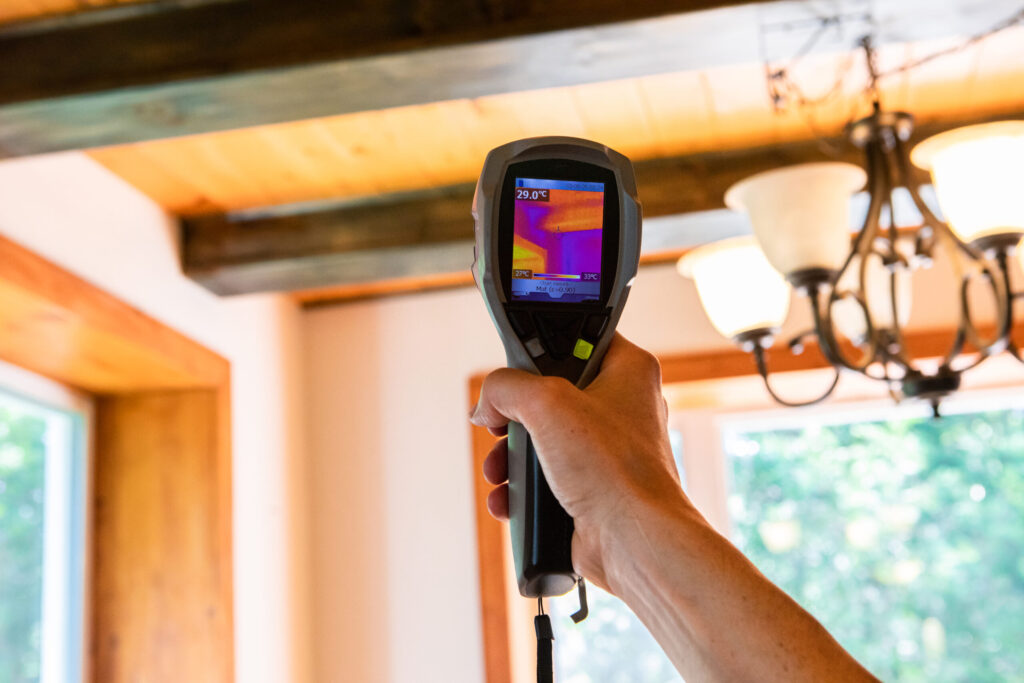
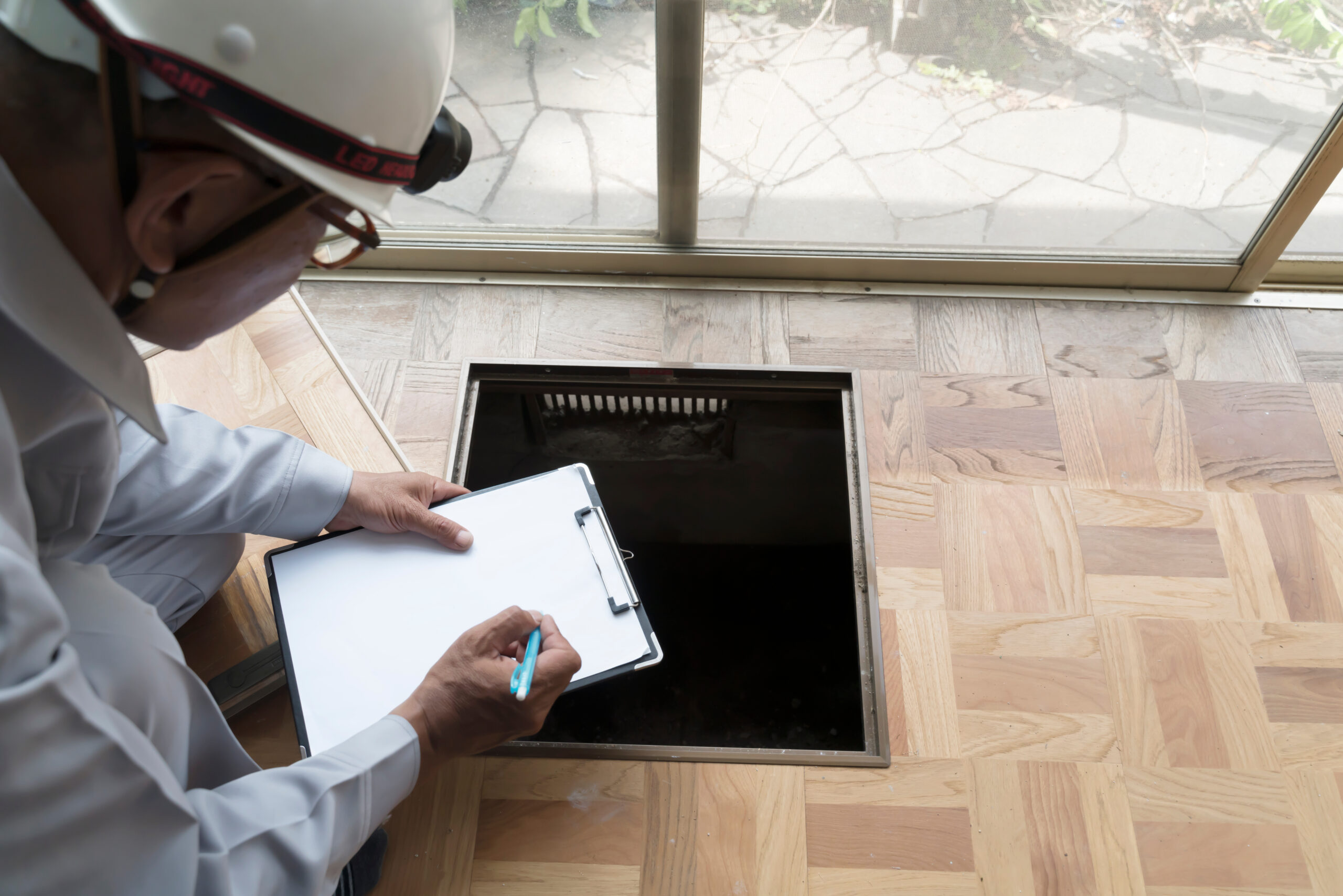
Mold testing on site covers the areas named in the inspection plus the assemblies those areas drain into. Moisture readings get taken across the affected materials. Samples get collected where the finding will actually turn on laboratory results, and sent to a laboratory for analysis. Under Sec. 1958.001(5)(C) that analysis is itself assessment activity, which is part of why the result arrives as a document rather than a phone call.

Nearby Mold Testing Service Areas

Trusted Mold Testing Resources

The Twenty-Five Square Foot Line

One threshold explains most of the confusing answers a buyer gets. Sec. 1958.102(c) provides that a person is not required to be licensed to perform mold remediation where the contamination affects a total surface area for the project of less than 25 contiguous square feet.

That is why a seller can say, in complete good faith, that mold was dealt with and that no certificate exists. Below the line, no license was needed, so no certificate was generated and none is owed to you. It does not mean nothing happened, and it does not mean the work was bad. What it means is that no independent party evaluated it, and no document records what was found or how far it went.

The useful response is not suspicion. It is to establish what condition the house is in now, which is a question mold testing can actually answer.

Mold testing inspection in DFW Texas

Why the Report Is Usable in a Negotiation

We do not bid the cleanup, and we could not if we wanted to. Sec. 1958.155(a) bars the same license holder from performing both mold assessment and mold remediation on one project, and subsection (b) bars owning an interest on both sides of it.

For a buyer that restriction is the point rather than an inconvenience. A report is only worth something in a negotiation if the party who wrote it has nothing to gain from the size of the scope it recommends. Texas took that argument off the table by statute, so a seller’s agent cannot dismiss the findings as a contractor drumming up work.

See Our Reviews in Allen, TX and Greater DFW

Mold Test DFW place picture
4.9
Based on 49 reviews
Michael Ewers profile picture
Michael Ewers
2 months ago
Mold Test DFW is great! Ryan was a HUGE help with my mold problem. My unit had mold. My apartment complex said there isn't mold and did not treat so I called Ryan and he was there same day! Ryan is easy to work with, punctual, and great to talk to. My fiancée and I are looking to buy a home in the future and Ryan will be our first call during our inspection period. 10/10 recommend Mold Test DFW

Michael Raines profile picture
Michael Raines
2 months ago
Mold Test DFW provides outstanding service to their customers. Ryan is responsive, extremely knowledgeable, and follows through to help customers understand the process fully.

Chris Falcon profile picture
Chris Falcon
3 months ago
Ryan did amazing work for us! My wife and I are in the middle of a quick option period for a house, and required a professional inspection done on a questionable bit of surface.

He was able to get in, do a complete thorough walkthrough, send samples off to the lab, and write a report up for us (that included a massive amount of broken down details), all before our option period ended.

Highly recommend using this company for anything, they definitely don’t disappoint!

S P. profile picture
S P.
3 months ago
Ryan is amazing and has gone above and beyond my expectations. My apartment complex has been very difficult throughout me trying to have Ryan do his assessment. The first time Ryan came out to do the assessment we were blocked and denied access to my apartment. It was a horrible situation I wasn't expecting. Ryan was very professional and asked appropriate questions when we were denied access. Throughout this on going process with the apartments, Ryan has been so kind. He is never in a rush and answers all your questions. I'm so grateful for his knowledge and the advice he has shared throughout this process I'm going through. I hope I don't ever have to deal with mold again but if I do I know who to call and I would definitely recommend him to anyone.

Meagan Pierini profile picture
Meagan Pierini
4 months ago
Ryan is incredible! I could not recommend Mold Test DFW more. He went above and beyond to fit me in last minute, was punctual, extremely knowledgeable and answered any questions I had. 10/10 service.

Jim S. profile picture
Jim S.
7 months ago
Ryan Rainey, the owner of Mold Test DFW, is amazing. We had him perform an inspection on a house we intend to purchase, and we are very happy with how he handled our need. After Ryan e-mailed the test results, he spent 45 minutes going over those results with us on the phone. Line by line he explained the problem, the solution, and the estimated cost, telling us along the way what was serious and what wasn't. He is the most thorough inspector I've ever dealt with on anything, and we recommend him to anyone with any type of mold issues. Thanks again, Ryan!!!

James Johnson profile picture
James Johnson
11 months ago
Ryan has been an absolute pleasure to work with. He’s consistently punctual, professional, and always goes the extra mile to make himself available even on short notice or clearance testing. His communication is clear and straightforward, and he always takes the time to explain exactly what needs to be done.
What really stands out is how easy he is to work with. Ryan makes the entire process smooth and stress-free. His attention to detail with paperwork is also top-notch—everything is always accurate, complete, and submitted promptly.
If you're looking for someone reliable, knowledgeable, and genuinely dedicated to their work, Ryan is the one to call. Highly recommended. United Water Restoration group Arlington, Texas Operations Manager, James Johnson

Curtis M profile picture
Curtis M
12 months ago
We had Mold Test DFW come out to test some dirty remediation equipment that another company had brought into our home after a water leak. I attached a few photos for reference so others can see what we were dealing with.

From the very beginning, Ryan was outstanding—he explained the testing process clearly, answered all of our questions, and made the entire experience stress-free. The appointment was scheduled quickly, and he arrived right on time with all of his professional equipment.

What really impressed us was how thorough and detail-oriented Ryan was. He didn’t just take air and surface samples—he explained each step of the process so we understood how the testing works and what the results would show. He was professional, respectful of our home, and very transparent about what he was doing.

Compared to other companies we’ve used in the past, Mold Test DFW was by far more honest and customer-focused. The final report was easy to understand, very comprehensive, and gave us peace of mind to move forward with the right remediation decisions.

If you need accurate, reliable, and trustworthy mold testing, I highly recommend Mold Test DFW. Ryan went above and beyond, and we’ll absolutely call them again in the future if we ever need testing.

What Goes Into a Mold Testing Report

A mold testing report is written to be read by someone who was not there. It names conditions, locations and the moisture mechanism behind them. Locations are recorded by room and by position within the house, so a reader can find the same spot. Where the evidence stops, the report says where it stops instead of filling the gap.

Where remediation is warranted, the protocol specifies the rooms, the material quantities, the methods and the proposed clearance criteria. That document is what you or the seller hand to a licensed remediation contractor, and it is the reason two contractors bidding the same job are bidding the same job.

What the Report Leaves to You and Your Agent

Mold testing establishes what is present and why. It does not decide what you should ask the seller for, and it does not price the repair. Those are decisions for you and your agent, informed by the report rather than dictated by it.

It also does not answer medical questions, which belong with a physician. And it does not assign legal responsibility between the parties to a contract. What it gives you is a defensible statement of the building’s condition on a specific date, which is what the rest of those conversations need in order to be productive.

Mold testing services in DFW Texas

Mold Testing Before You Are Under Contract

Access belongs to the owner, so mold testing before an offer happens only with the seller’s permission. Some sellers grant it and some do not, and asking costs nothing.

More often the assessment happens after execution, when the right of entry is already established by the contract and the option period sets the boundary. Either way the work is the same and the report is the same. The only thing that changes is who has to say yes before anyone opens a door.

Inspector greets homeowners

Get the Answer Before Your Option Period Closes

Send the address, the executed contract date if there is one, and the page of the inspection report that raised the question. If your agent has already asked the seller for the certificate history, tell us what came back. What you get is a written assessment you can put in front of the other side of the transaction.

Allen Mold Testing Questions From Buyers

How do I ask a seller for the mold certificate history?

Have your agent request, in writing, copies of any certificate of mold remediation issued for the address in the preceding five years, citing Sec. 1958.154(b). Put it in the same message as your other document requests so it reads as routine, which it is.

Ask anyway, and get the answer in writing. The statutory duty attaches to certificates that exist, so a general reassurance is not the same thing as a response. A written no belongs in your file at closing.

It means a mold assessment license holder signed off that the contamination identified for that project was remediated as the protocol laid out. It does not certify that the water source was corrected. That is the gap worth checking, because a corrected symptom above an uncorrected source comes back.

Only with the owner’s permission, because access is theirs to grant. It is worth asking. If the answer is no, the option period after execution is when the right of entry is already established by the contract.

That is common, and it usually means the project fell under Sec. 1958.102(c), which exempts remediation affecting less than 25 contiguous square feet from the licensing requirement. No license, no certificate, nothing owed to you. An assessment tells you the current condition, which is the more useful thing anyway.

It gives you the basis for that decision rather than the decision itself. The report identifies conditions, locations and the moisture mechanism, and where remediation is warranted it defines the scope and the clearance criteria. What you request is between you and your agent.

Usually not on its own. A general inspection that turned up no staining, no odor and no unusual moisture readings is a reasonable place to stop. Go further when something specific was noted, when the house has a known water history, or when a certificate turns up and you want to know whether the source behind it was addressed.