

Mold Testing in Balch Springs, Texas
Mold Testing for Balch Springs Rental Property Owners
A tenant sends a photo of a dark patch at the bottom of a closet wall. Somebody has already told them what it is. Now there is a maintenance obligation, a lease nobody wants read aloud in a courtroom, and at least one company willing to come look for free and then quote the cleanup.
What a property owner needs first is a fact pattern: what is actually there, how far it runs, and which building failure is putting water into that wall. Without those three things, every decision after it rests on somebody’s estimate, including the size of the repair and the wording of what you send the tenant.
Mold Test DFW is a mold testing and assessment company. We test, we measure, we write the report, and we have no cleanup to sell.
Free Mold Testing From the Company Selling the Cleanup
That free inspection is worth understanding rather than resenting. Under Texas Occupations Code Sec. 1958.155(a), a license holder may not perform both mold assessment and mold remediation on the same project. Subsection (b) closes the workaround: nobody may hold an ownership interest in both the assessing entity and the remediating entity on that project.
Note how narrowly that is drawn. Texas does not say a company can never do both kinds of work. It says the same license holder cannot stand on both sides of one project. The line is drawn at the project, tightly enough that subsection (d) needed a specific carve-out for a license holder employed by a school district working on that district’s own project.
For an owner of rental property the consequence is structural rather than a matter of trust. The party that defines how big the job is cannot be the party that bills for it. A larger measured area cannot become a larger invoice on our side, because we do not have an invoice on that side. Mold testing and the cleanup are two engagements by design.
100% Privacy Guarantee
What the Under-Ten-Units Exemption Does Not Do
There is a second provision owners hear about and often misread. Sec. 1958.102(e) exempts owners and agents of residential property with fewer than ten dwelling units from the chapter’s licensing requirements, unless they engage in the mold business for the public.
That is a rule about who is permitted to perform the work. It is not a statement that documentation does not matter for small portfolios, and it does not travel with you into a dispute. An adjuster, an attorney or a tenant asking what was found in that closet is not asking whether you needed a license. They are asking what the record says, and the exemption produces no record at all. Mold testing is what produces one.
100% Privacy Guarantee
Seven Communities Inside One City Limit
Balch Springs has a history that shows up in its buildings. The Balch family settled the area around 1870 and found three springs, which is where the name comes from. By 1900 there was a cemetery and scattered farms and not much else.
Then on June 13, 1953 the city incorporated, and the area it took in encompassed sections of seven separate communities: Rylie, Kleberg, Five Points, Zipp City, Jonesville, Balch Springs itself and Triangle. Those pieces were laid out at different times by different people to different standards, and they are now 9.02 square miles under one set of city limits. Mold testing here starts with which of those pieces a property sits in.
100% Privacy Guarantee
Why Two of Your Units Fail Differently
An owner with units in more than one part of the city feels that history directly. Two houses a couple of miles apart can come from different decades, which means they fail in different ways and the same tenant complaint points at different causes.
Older stock is more likely to hand you original drain lines, a re-roofed shallow-pitch section, an added room with a step in the floor, or a slab edge detail nobody would draw today. Newer stock is more likely to hand you a mechanical closet, a condensate line and a shower pan. Mold testing starts by establishing which of those a unit is.
How the City Filled In
The population figures are worth reading as a construction timeline. Balch Springs held about 3,500 residents in 1956, then 10,464 by 1970 and 13,050 by 1976. It reached 17,406 in 1990, 19,375 in 2000, and 27,685 at the 2020 census. By the late 1970s it had become a community whose residents largely commuted into Dallas for work.
Interstate 635, Interstate 20 and U.S. Highway 175 all reach the city, which is a large part of why that commuter pattern took hold and why the housing went up in the waves it did.
What a Rental Portfolio Inherits
Owner-occupancy runs at about 64.7 percent, so a meaningful share of the housing here is rented, much of it built in those growth waves rather than purpose-built as rental stock. That matters. A house designed for an owner and then let out tends to accumulate deferred items in the places an owner would have noticed and a tenant will not. Think of the attic, the crawl space, the water heater closet and the grade against the back wall. Mold testing tends to find them there.
Mold Testing in a Unit Someone Lives In
Most mold testing here happens in units somebody is living in, which shapes the logistics more than the method. Useful to send over before the visit:
- the unit address and what the tenant reported, with the date they reported it
- whether any repair has been attempted, and whether one is still pending
- how notice of entry works under your lease
A pending plumbing or roof repair is a reason to wait a few days rather than to hurry. Measuring an assembly that is about to be reopened wastes the visit. It is also worth knowing that an assessment is an inspection and sampling visit rather than construction. Questions about whether anyone needs to be out of the unit generally belong to the remediation contractor’s work plan rather than to this step.
What a Mold Testing Visit Covers
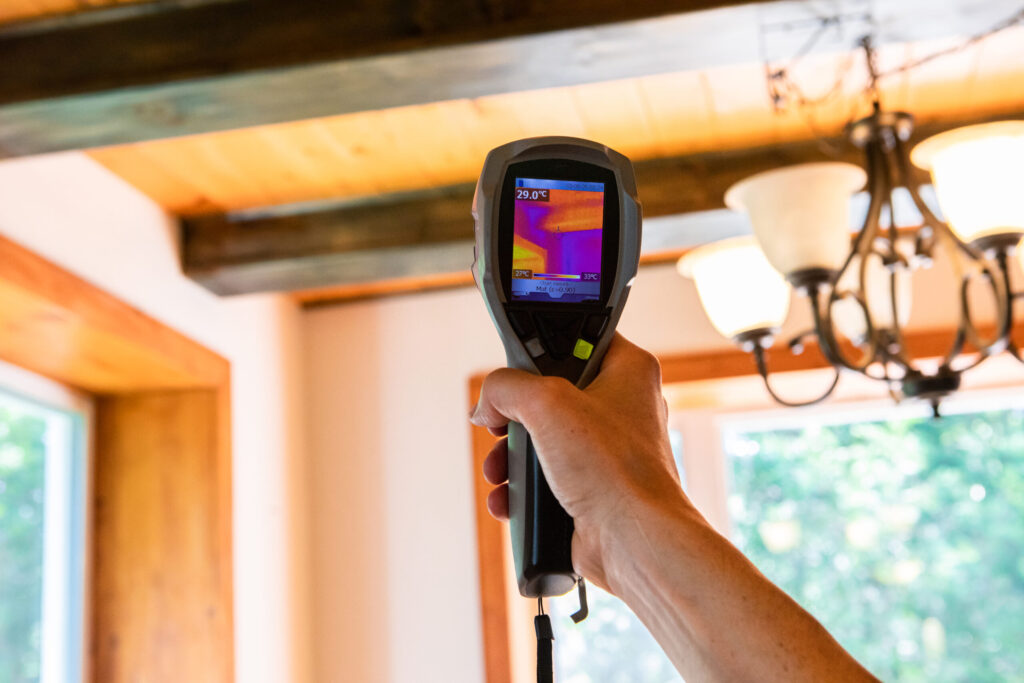
Mold testing covers the reported area and the assemblies connected to it, not the photograph alone. Moisture readings go across the affected materials and the surfaces around them, and the boundary of any affected area gets recorded as a measurement rather than a description.
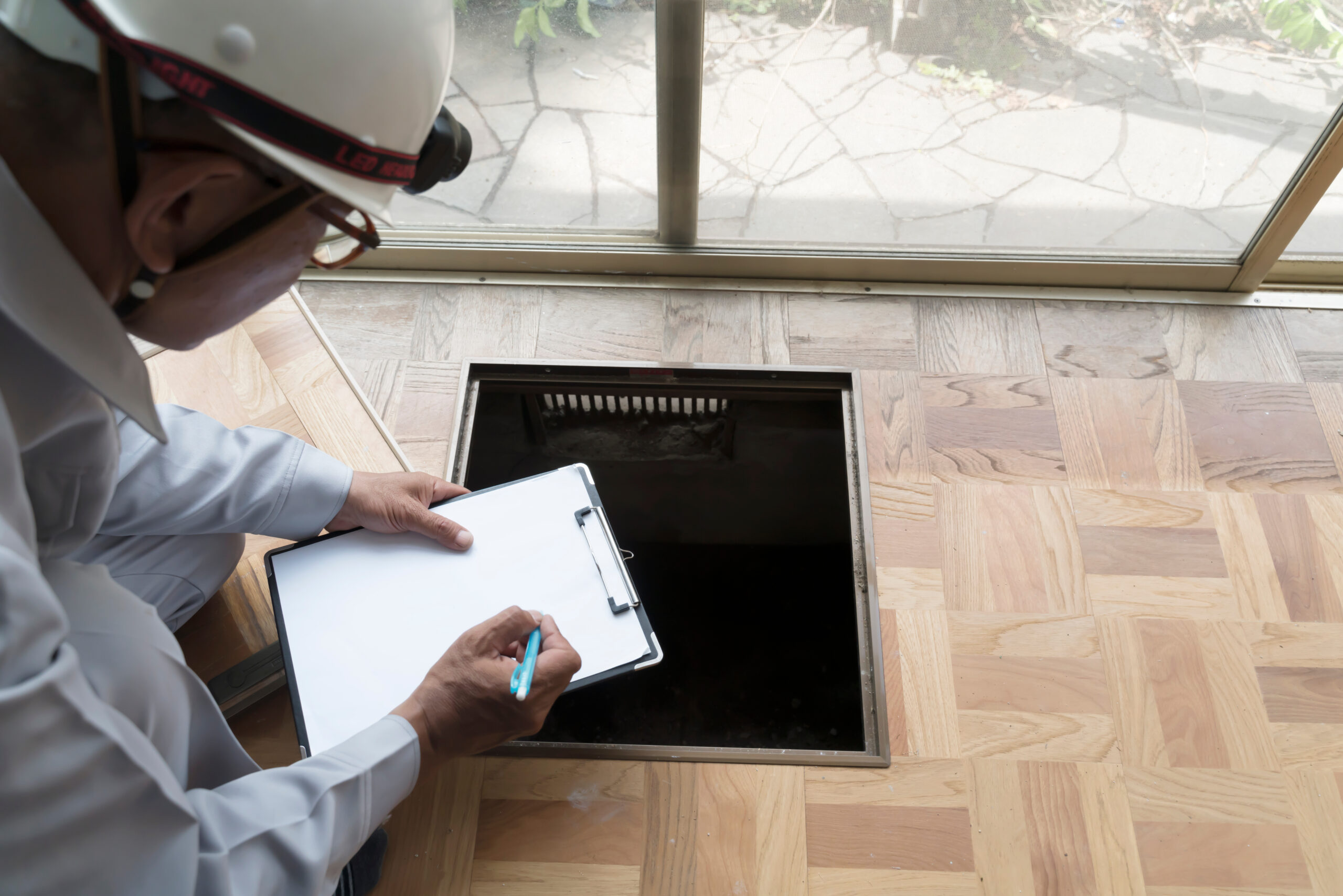
Where the finding turns on laboratory results, samples are collected and sent for analysis, and each result is reported with the location it describes. Where a conclusion would require opening something up that nobody has opened, the report says so instead of guessing.
The Document You End Up Holding
What you end up holding is a dated written record of one specific unit: locations, measured extent, and the moisture source where the evidence supports naming one. That is what a mold testing report is for.
If remediation is warranted, the protocol names the rooms, the material quantities, the methods and the proposed clearance criteria. That is the document you hand out when you take bids. Bids written against a defined scope can be compared line by line. Bids written against a walkthrough leave you guessing at what each one actually covers, which is how two numbers that look far apart turn out to be for different jobs.


He was able to get in, do a complete thorough walkthrough, send samples off to the lab, and write a report up for us (that included a massive amount of broken down details), all before our option period ended.
Highly recommend using this company for anything, they definitely don’t disappoint!



What really stands out is how easy he is to work with. Ryan makes the entire process smooth and stress-free. His attention to detail with paperwork is also top-notch—everything is always accurate, complete, and submitted promptly.
If you're looking for someone reliable, knowledgeable, and genuinely dedicated to their work, Ryan is the one to call. Highly recommended. United Water Restoration group Arlington, Texas Operations Manager, James Johnson

From the very beginning, Ryan was outstanding—he explained the testing process clearly, answered all of our questions, and made the entire experience stress-free. The appointment was scheduled quickly, and he arrived right on time with all of his professional equipment.
What really impressed us was how thorough and detail-oriented Ryan was. He didn’t just take air and surface samples—he explained each step of the process so we understood how the testing works and what the results would show. He was professional, respectful of our home, and very transparent about what he was doing.
Compared to other companies we’ve used in the past, Mold Test DFW was by far more honest and customer-focused. The final report was easy to understand, very comprehensive, and gave us peace of mind to move forward with the right remediation decisions.
If you need accurate, reliable, and trustworthy mold testing, I highly recommend Mold Test DFW. Ryan went above and beyond, and we’ll absolutely call them again in the future if we ever need testing.
Certificates Are Worth Filing
When a remediation contractor finishes, Sec. 1958.154(a) requires them to give the owner a certificate of mold remediation within ten days. That certificate carries a mold assessment license holder’s statement that, on visual, procedural and analytical evaluation, the contamination identified for the project was remediated as the plan or protocol set out.
File those. Under Sec. 1958.154(b), a property owner who sells must give the buyer a copy of each certificate issued for the property in the five years preceding the sale. A landlord is a future seller, and the certificate you cannot find later is the one a buyer will ask about.
Questions a Mold Testing Report Does Not Answer
A mold testing report identifies the moisture source where the evidence supports one, such as a failed supply line, a roof penetration or a condensate line. How that maps onto responsibility under a lease is a legal question, and it belongs with an attorney rather than with us.
The same goes for disclosure obligations, for coverage decisions, and for anything medical. What the report settles is the building question: what is present, in which unit, over what measured area, and what water is feeding it.
Mold Testing Across Eastern Dallas County
We assess rental and owner-occupied property across Dallas County. The city took in part of Kleberg when it incorporated, and we publish pages for Mesquite and Dallas as well, with the full list on our areas served page.
Owners running several units in one building will find more on our apartment mold testing page. For background on why moisture is the thing to control, the EPA mold resources are a sound starting point.
Get the Unit Documented
Send the unit address, the date the tenant reported it, and whether a repair is finished or still pending. Tell us how notice of entry works under your lease and we will plan around it. What comes back from mold testing is a written record of that unit on that date, which is the thing every later conversation needs.
Landlord Questions About Mold Testing
My restoration contractor offered to test for free. Why pay for an assessment?
Because of who is permitted to do what. Sec. 1958.155 bars a license holder from assessing and remediating the same project, so a company that intends to perform the cleanup cannot be the assessment license holder on it. Two separate engagements is the arrangement the statute contemplates, and it is also the one that produces a scope nobody profits from enlarging.
Can you tell me whether the tenant caused it?
The report identifies the moisture source where the evidence supports one, such as a failed supply line, a roof penetration or a condensate line. How that maps onto responsibility under your lease is a legal question for your attorney. What we can give you is the factual half of that argument.
Do I have to disclose the report to my tenant?
Ask your attorney, because disclosure turns on your lease and on Texas property law rather than on the mold chapter. What the statute addresses directly is the certificate of mold remediation, which Sec. 1958.154(b) requires be given to a buyer when the property sells.
I own a fourplex. Am I exempt from all of this?
Sec. 1958.102(e) exempts owners and agents of residential property with fewer than ten dwelling units from the chapter’s licensing requirements, unless they engage in the mold business for the public. That governs who may perform the work. It does not mean a written record is worth less, and the exemption itself produces no record.
Who has to sign off that the cleanup worked?
Not the company that did it, on its own. Sec. 1958.154(a) requires the certificate to carry a statement from a mold assessment license holder, based on visual, procedural and analytical evaluation, that the identified contamination was remediated as the protocol set out. That evaluation is assessment work, so it comes from the assessment side rather than the remediation side. Ask us about that step when you scope the project.
What if I own several units in the city?
Tell us the addresses and what each tenant reported. Each unit gets its own written record, because a lease, a claim and a repair all attach to a single address rather than to a portfolio. Having them documented the same way is the part that makes them comparable later.
Can you test a unit between tenants?
Yes, and a vacant unit is the simplest case, with no notice of entry to work around. A turnover is also a sensible moment to put the condition of the unit in writing before the next lease starts.